VECTOR EMBEDDINGS / JULY 18, 2026 / 8 MIN READ
The Complete Guide to Vector Embeddings
Building Semantic Search, RAG, Recommendation Systems, and Modern AI Applications

Saptyadeep Bhattacharjee/Updated July 18, 2026
Building Intuition for Vector Embeddings
Before we can understand vector embeddings, we need to understand the problem they were invented to solve.
1. Why Embeddings Exist
Imagine asking a friend:
"Recommend a movie like Interstellar."
They might suggest The Martian, Arrival, or Gravity, even though none of these movies share many exact words with "Interstellar." They understand the meaning behind your request.
A computer, however, doesn't naturally understand meaning. It only sees symbols—letters, words, numbers, or bytes. To a machine, "dog" is just a sequence of characters, not a furry animal.
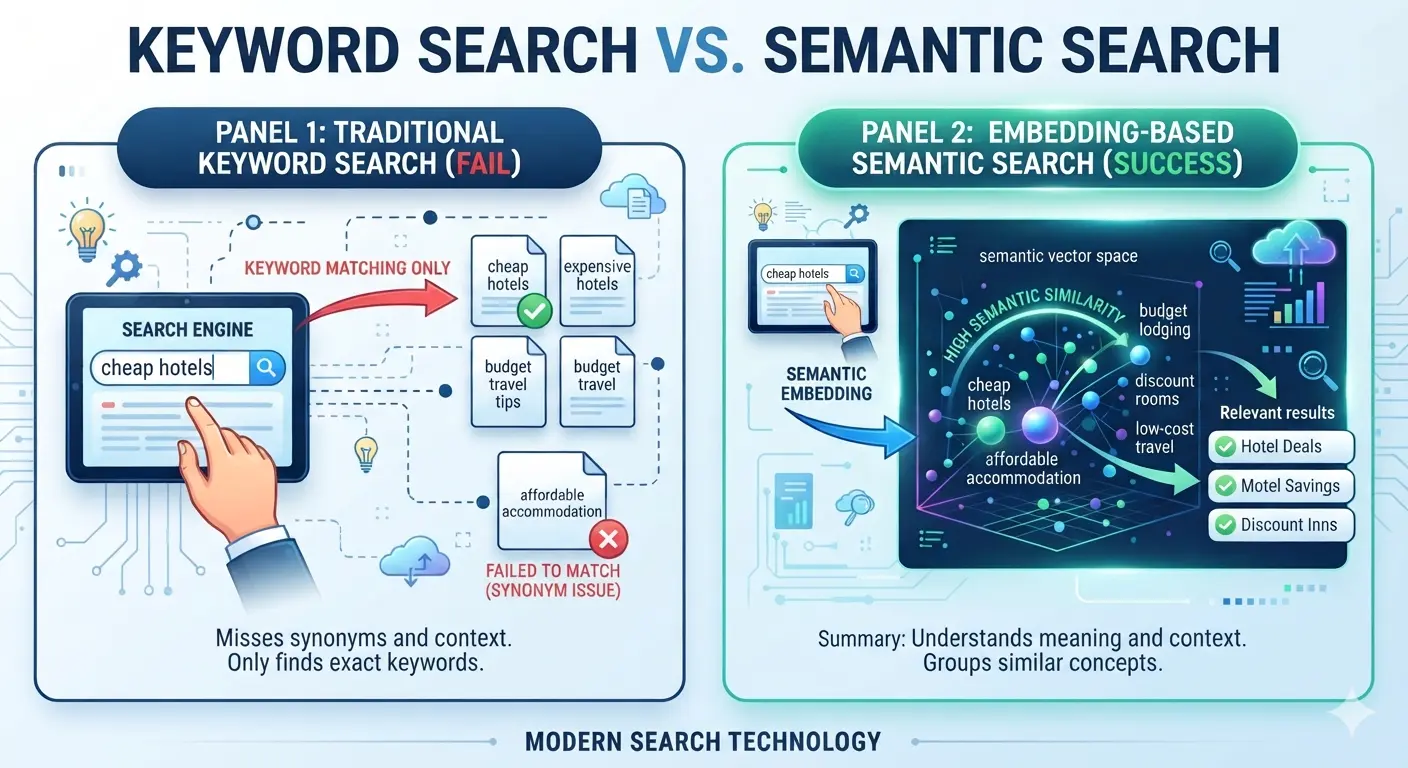
Early search engines relied on keyword matching. If you searched for "cheap hotels," a page containing "affordable accommodation" might never appear because it didn't contain the exact words "cheap" or "hotels."
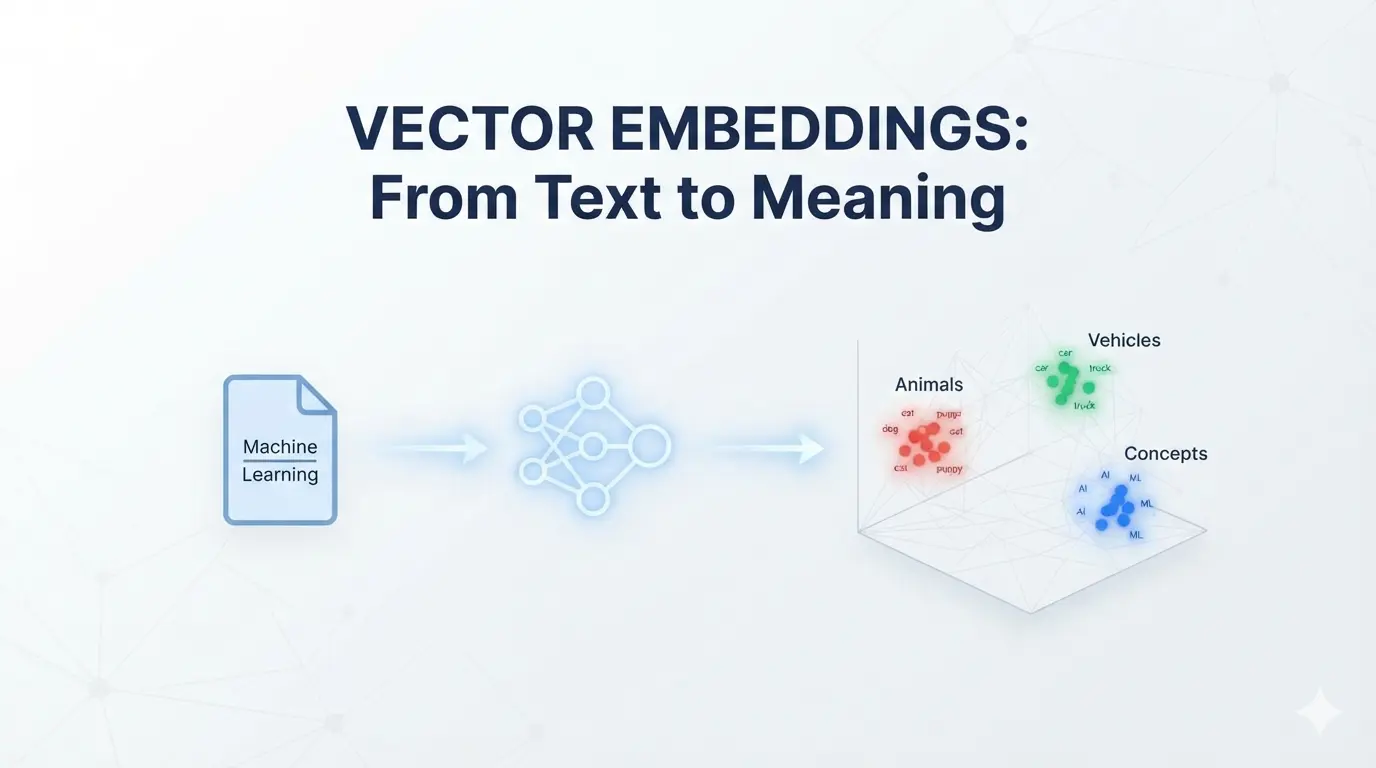
Embeddings were invented to solve this problem. Instead of representing data as isolated words or IDs, embeddings convert information into vectors that capture semantic meaning. Objects with similar meanings end up close together in a mathematical space, enabling machines to reason about similarity rather than exact matches.
2. Structured vs Unstructured Data
Computers excel at structured data—organized information stored in rows and columns.
| Structured Data | Example |
|---|---|
| Age | 25 |
| Salary | ₹12 LPA |
| Height | 170 cm |
These values already have numerical meaning.
Most real-world information, however, is unstructured:
- Text
- Images
- Audio
- Videos
- Source code
- PDFs
A sentence like "The sunset over the mountains was breathtaking" has rich meaning but no inherent numerical representation. Neural networks require numbers, so unstructured data must first be transformed into a machine-readable form.
That transformation is the role of embeddings.
3. Feature Engineering
Before deep learning, engineers manually designed features—numerical descriptions intended to capture useful information.
For an email spam detector, features might include:
- Number of links
- Presence of "FREE"
- Number of capital letters
- Email length
These handcrafted features were fed into machine learning models.
While effective for simple problems, manual feature engineering demanded significant domain expertise and often failed to capture deeper patterns or context.
4. Why Manual Features Fail
Real-world data is too complex for handcrafted rules.
Consider these sentences:
- "This phone is fantastic."
- "This phone is amazing."
- "I absolutely love this device."
A human immediately recognizes that all three express positive sentiment.
A manually engineered system sees mostly different words.
Language is highly contextual. Synonyms, slang, spelling variations, multilingual text, and evolving vocabulary make handcrafted features brittle and difficult to maintain.
Deep learning replaced manual features by learning representations directly from data, giving rise to embeddings.
5. What is a Vector?
A vector is simply an ordered list of numbers.
Example:
[0.18, -0.52, 0.91, 0.34]
You can think of a vector as the numerical "DNA" of an object.
Different kinds of data can all become vectors:
- Documents
- Images
- Songs
- Products
- Users
- Code snippets
The numbers themselves are not directly interpretable. Their importance lies in how they relate to other vectors.
6. High-Dimensional Space
A vector with three numbers can be plotted in 3D space.
Modern embeddings often contain:
- 384 dimensions
- 768 dimensions
- 1024 dimensions
- 1536 dimensions
- 3072 dimensions
Humans cannot visualize such spaces, but mathematically they behave like higher-dimensional versions of ordinary space.
In this space:
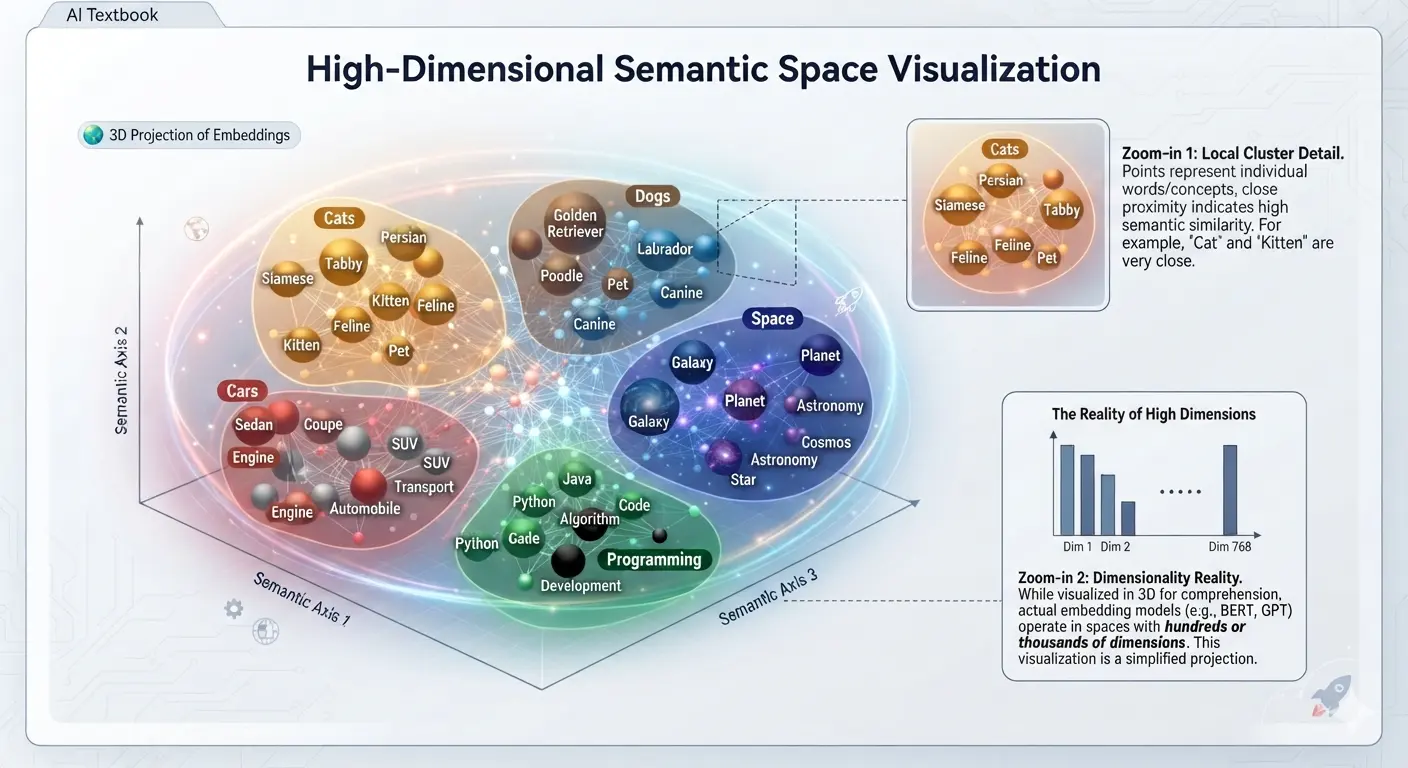
- Similar objects cluster together.
- Dissimilar objects are far apart.
7. What is an Embedding?
An embedding is a vector that preserves the meaning of an object.
Rather than storing only raw data, an embedding captures semantic relationships.
For example:
| Input | Concept |
|---|---|
| Dog | Animal, pet |
| Puppy | Young dog |
| Cat | Animal, pet |
| Car | Vehicle |
The embeddings for Dog and Puppy will be close together, while Dog and Car will be much farther apart.
The exact numbers are unimportant—the relative positions encode meaning.
You can insert the following section immediately after "What is an Embedding?"
8. What is a Vector Embedding?
Now that we know what a vector is and what an embedding is, let's combine the two ideas.
A vector embedding is a numerical representation of an object that captures its meaning, context, and relationships with other objects.
In other words,
Vector Embedding = Meaning encoded as a vector
Unlike ordinary vectors, whose numbers may represent explicit quantities such as height, weight, or age, the numbers inside a vector embedding do not have individual meanings.
Consider this embedding:
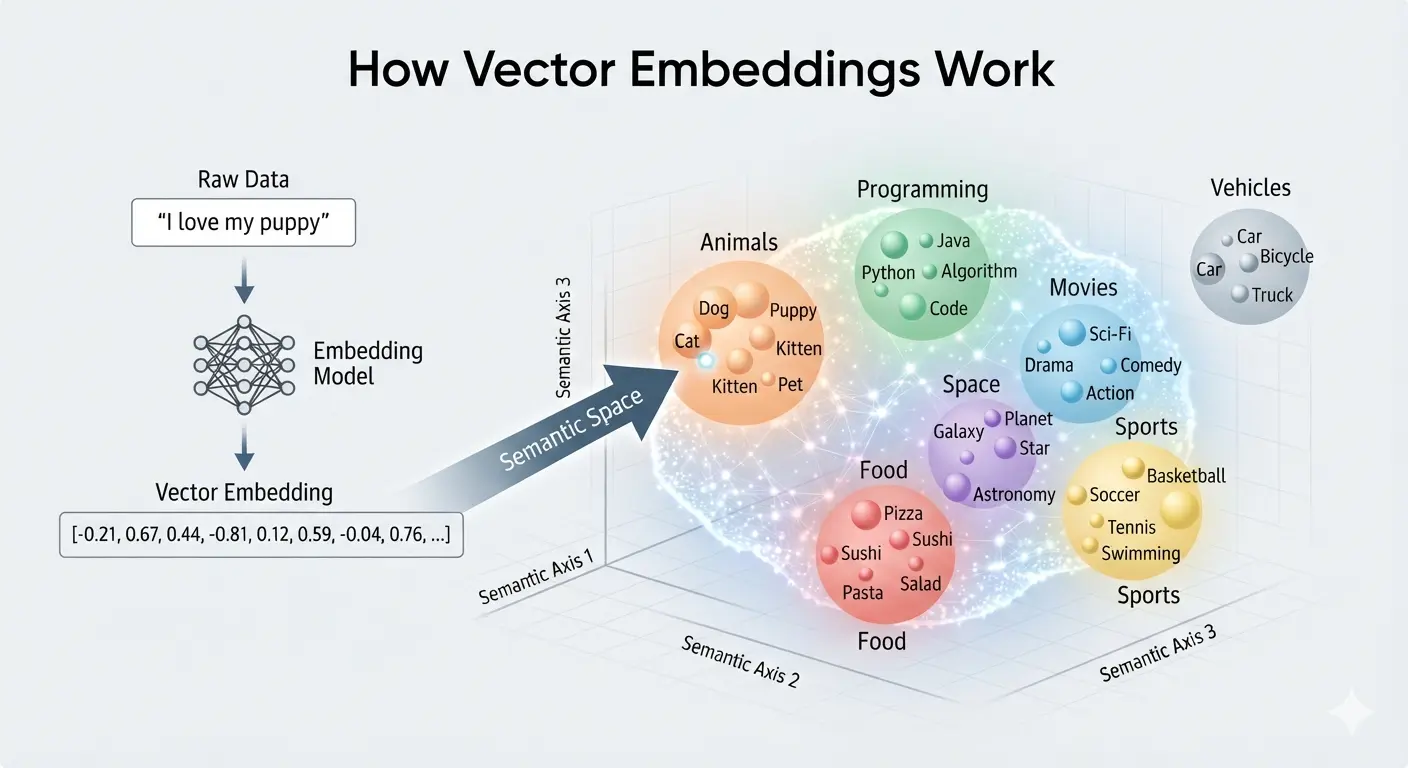
[-0.183, 0.942, -0.511, 0.276, ...]
Looking at these numbers tells us nothing.
However, when we compare this embedding with thousands or millions of other embeddings, something remarkable happens:
- Similar concepts appear close together.
- Unrelated concepts appear far apart.
- Hidden relationships naturally emerge.
For example, after an embedding model processes millions of documents, the semantic space may look something like this:
| Word | Nearby Words |
|---|---|
| Dog | Puppy, Labrador, Pet, Animal |
| Cat | Kitten, Feline, Pet |
| Apple | iPhone, MacBook, iPad |
| Python | Programming, NumPy, Django |
| Football | Soccer, FIFA, Goal |
The model was never explicitly told that these words are related. It learned these relationships automatically by observing patterns in massive amounts of data.
Think of It Like a Map
Imagine a giant world map.
Cities that are geographically close appear near each other.
Similarly, in an embedding space:
- Similar ideas become neighbors.
- Different ideas drift apart.
Instead of measuring physical distance, we measure semantic distance.
9. Embedding Models
Embeddings are generated by specialized neural networks called embedding models.
Popular examples include:
- Sentence Transformers (SBERT)
- OpenAI Embeddings
- Google's Gemini Embeddings
- Cohere Embed
- BGE (Beijing Academy of AI)
- E5 Embeddings
Each model has been trained on massive datasets to learn semantic relationships between words, sentences, images, or other data types.
Different models are optimized for different tasks, such as retrieval, clustering, recommendation, or multilingual understanding.
10. Dense vs Sparse Representations
There are two common ways to represent data numerically.
Sparse Representation
Most values are zero.
Example:
[0, 0, 1, 0, 0, 0, 0, 1]
One-hot encoding is a classic sparse representation. It is simple but cannot express similarity between concepts.
Dense Representation
Almost every value contains useful information.
Example:
[-0.27, 0.81, 0.14, -0.55, 0.62]
Dense embeddings are compact, efficient, and capable of encoding semantic meaning. They form the foundation of modern AI systems, including semantic search, recommendation engines, Retrieval-Augmented Generation (RAG), and large language models.
11. Real-World Applications of Vector Embeddings
You can end the section with the following "Real-World Applications" subsection.
Real-World Applications of Vector Embeddings
Once data has been transformed into vector embeddings, an entirely new class of intelligent applications becomes possible. Instead of relying on exact keyword matches, these systems operate on meaning, enabling far more natural and accurate user experiences.
| Application | How Vector Embeddings Are Used |
|---|---|
| 🔍 Semantic Search | Retrieve documents based on meaning rather than exact keywords. Searching for "cheap hotels" can return results containing "affordable accommodation." |
| 🤖 Retrieval-Augmented Generation (RAG) | Convert documents into embeddings, retrieve the most relevant chunks for a user's query, and provide them as context to a Large Language Model (LLM). |
| 🎬 Recommendation Systems | Recommend movies, songs, products, or articles by finding items with embeddings similar to those a user previously liked. |
| 🖼️ Image Search | Upload an image and retrieve visually or semantically similar images, even without matching filenames or tags. |
| 💻 Code Search | Search source code using natural language queries like "binary search implementation" or "JWT authentication middleware." |
| 🌍 Multilingual Search | Retrieve documents written in different languages because embeddings place semantically equivalent sentences close together regardless of language. |
| 😊 Sentiment Analysis | Classify whether text expresses positive, negative, or neutral sentiment using learned semantic representations. |
| 📂 Document Clustering | Automatically group similar documents, news articles, research papers, or customer feedback into meaningful categories. |
| 🏷️ Text Classification | Classify emails, support tickets, legal documents, or medical reports based on semantic content rather than manually engineered rules. |
| 👥 Customer Segmentation | Represent users as embeddings based on their behavior to identify similar customers for personalization and targeted recommendations. |
| 🎙️ Audio & Speech Search | Find similar voice recordings, podcasts, or music using audio embeddings instead of metadata. |
| 🧬 Scientific Research | Compare proteins, molecules, DNA sequences, and biomedical literature using learned embeddings to accelerate discovery. |